Optical & Contact Lens Clinic

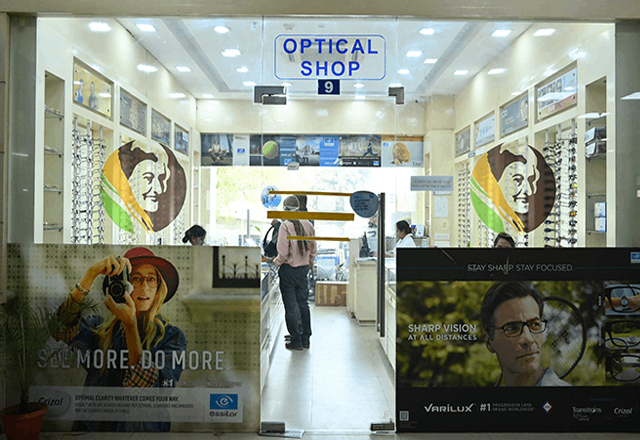
Refractive and Optical

Indira Gandhi Eye Hospital and Research Centre has a modern cornea and refractive surgery units, equipped with advanced technology. Experienced doctors offer a range of treatments for all kinds of corneal diseases, ocular surface disorders and refractive surgery cases.
Technical set up

Treatments available

The department offers to the efficient diagnosis and management of a wide range of diseases

Procedures and surgeries

The department has a basket of surgeries to offer and provide most recent advances in the field of cornea and refractive surgery which include:

Penetrating keratoplasty (PK)
Optical, tectonic and therapeutic PK, Paediatric PK, Sectoral Corneal graft, Anterior segment reconstruction, K prosthesis.
Lamellar corneal surgeries
Including Deep Anterior Lamellar Keratoplasty (DALK), Descemet's Stripping Endothelial Keratoplasty (DSEK), Sclero-Corneal lamellar graft for Limbal Dermoid, Patch DALK
Refractive corneal surgery
Refractive surgery for various laser refractive procedures such as LASIK, Epi-LASIK, Wavefront guided customized ablation, PRK.
Customised laser refractive surgery: A strategy to correct not only the refractive error but also the other optical imperfections of the eye, known as aberrations.
Phakic IOL- Implantable Collamer Lens (ICL/IPCL) is a lens implant that can be used for correction of refractive errors (myopia, hyperopia and astigmatism).
Phaco-refractive surgery with IOL for the patients not fit for LASIK or ICL.
Ocular surface reconstruction surgeries that include Sclero-corneal graft for combined scleral and corneal melt.
Eye trauma management: Eye globe rupture repair, Corneal tear repair with lens implantation, Intra ocular foreign body removal.
Ocular surface disorder treatment: Treats various disorders such as pterygium, dry eyes, computer vision syndrome and ocular surface squamous neoplasia. Various surgical procedures such as conjunctival limbal autograft, conjunctival autograft, simple limbal epithelial transplantation (SLET), amniotic membrane transplantation and mucous membrane transplantation are performed.
Specialised contact lens fitting clinic for irregular cornea, keratoconus and for therapeutic purposes
Collagen cross linking (C3R, CXL) for keratoconus: We perform Collagen Cross Linking for keratoconus using the world’s best accelerated cross-linking system.
The department is equipped with microbiological and histopathological evaluation of diseases of external eye diseases.

Frequently Asked Questions

What is the most common cause of congenital cataract?

The majority of bilateral congenital or infantile cataracts have no identifiable cause. Genetic mutation and familial transmission are the most common cause.

Surgical removal of cataract with or without IOL implantation is the only treatment of congenital cataracts.

Surgery should be performed between four to eight weeks of age

It’s a type of glaucoma in which high fluid pressure in eye damages the optic nerve. It affects children between birth and three years of age.

You may notice that your baby closes her/his eyelids, seems painfully sensitive to light and tears up a lot. Your child may also have large eyes (cornea) and cloudy cornea.

Surgery is the only treatment of Primary Congenital Glaucoma.

Strabismus (crossed eyes) is when your eyes are not lined up properly and they point in different directions.

Cataract surgery is a day care procedure, so you go home shortly after the surgery. You’ll need someone to come with you who can drive you home.
Here’s what to expect during the surgery:
Numbing medication: Your provider numbs the eye with drops or an injection. You may also get medication to help you relax. You will be awake during the surgery and see light and movement. But you won’t see what the ophthalmologist is doing to your eye. The surgery won’t hurt.
Cataract removal: Your provider uses a special microscope to see your eye. He/she creates tiny incisions to reach the lens. Then as ultrasound waves are used to break up the lens and remove it. Finally, the new lens is placed.
Recovery: You won’t need stitches. The tiny incisions close by themselves. Your provider will tape a shield (like an eye patch) over your eye to protect it.

Treatment may include glasses, patching, eye exercises and/or surgery.

IGEHRC, Gurugram

Sector 62, Gurugram122002, Haryana

0124-271-0271 | +91-966-762-0071

Mailus@igehrc.org

This will close in 20 seconds

Scroll to Top